Arnold Palmer,
son of a Pennsylvania golf pro and greenskeeper,
grew up on the fairways of Latrobe Country Club about 80 miles
from Pittsburgh. His first love was playing and competing, but
the question of what makes a great golf hole always fascinated
him.
ILLINOIS:
Hawthorn Woods Country Club
ARIZONA:
Starr Pass Country Club & Spa
When he officially
entered the field of course design in 1971,
Palmer was more than ready to translate his ideas onto the
landscape.
VIRGINIA:
Bay Creek
Belmont Country Club
Collaborating with
noted architect Ed Seay, Arnold embarked
on a design career that contributed to golf’s growth even as
it
extended his own fame.
VIRGINIA:
Dominion Valley Country Club
One of Palmer’s
early forays into course design for residential
developments was The General, a bold layout that would be the
last of the original four courses built at PGA National in
Palm
Beach Gardens. The General, at 6,768 yards, opened in early
1984.
FLORIDA:
PGA National
Contrary to
Palmer's risk-taking style as a player, Palmer the
designer has stayed away from trend-setting signatures, such
as railroad ties or rock gardens, in favor of a conservative
approach that favors quiet quality over eye-candy that may
become dated over time.
FLORIDA:
Frenchman's Reserve
Reunion
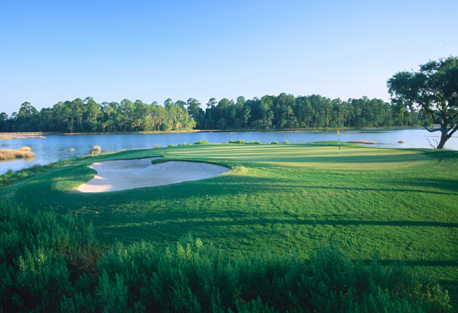
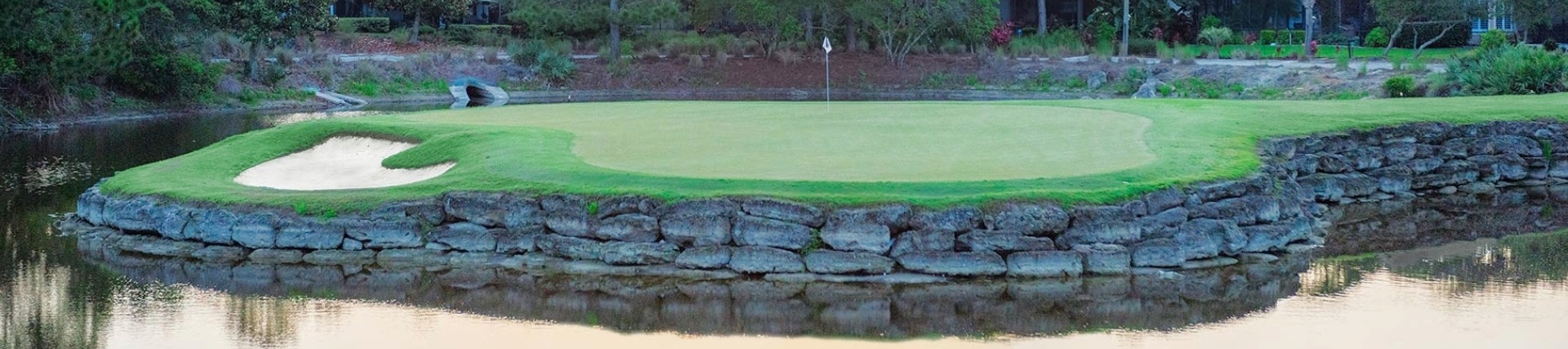
Having done so many
Florida courses, however, the Palmer
Design team has extensive experience with water as a design
feature. In fact, when you see lakes and ponds smoothly
transitioning into their adjacent fairways and snaring the
poor
shots while sparing the decent ones, there's a good chance the
course bears the Palmer signature.
FLORIDA:
Orchid Island
Developers who set
about building large, multi-course
communities have been quick to include the Palmer name--and
the sometimes playful Palmer style--in their course
collections.
GEORGIA:
Riverwood Plantation
(one of three nines)
Arnold’s entry in
the six-course complex at The Landings, on
Skidaway Island, Georgia, include the oak-lined Marshwood
course that he co-designed with Frank Duane. Palmer must
have had a smile on his face when, on the original plan, he
had a palm tree built right into the 16th green.
GEORGIA:
The Landings
(2 courses)
Another recent
example of a multi-course development tapping
into the Palmer reputation for quality and consistent
challenge
is Suncadia, in the dry uplands of Washington state, east of
Seattle.
Courses by Tom Doak and Jacobsen-Hardy also beckon the
traveling golfer at Suncadia, but Palmer’s 7,100-yard
Prospector
course at Suncadia stands out.
WASHINGTON:
Suncadia
Of all U.S. courses
in the Palmer portfolio, Suncadia may have
the most dramatic mountain views and the boldest fairway
contours.
Perhaps its only equal in that regard is the mountain-meadow
beauty Palmer fashioned at Running Y Ranch in Klamath Falls,
Oregon.
OREGON:
Running Y Ranch
A course designer
faces competing priorities, but for Palmer
the aesthetic need for his courses to fit smoothly into their
natural sites has been critical. His award-winning Old Tabby
Golf Links at the environmentally pioneering community of
Spring Island, S.C., showed the world how capable the Palmer
team was of respecting and preserving a fragile natural
environment
while still producing great golf.
SOUTH
CAROLINA:
Spring Island [
In autumn of 2006,
Arnold Palmer quit playing tournament golf
and the Palmer Design Company moved its offices from Ponte
Vedra Beach, Florida, to new quarters at Palmer’s own Bay Hill
Club at Orlando.
FLORIDA:
Tesoro
The firm left a
legacy in Ponte Vedra in the form of The Plantation
at Ponte Vedra, a lush yet links-style course that adds much
to
The Plantation’s oceanfront allure.
To see a complete list of
Arnold Palmer-designed courses on
GolfCourseHome.net,
click here.
Other Articles in the Golf
Architect Series
I. The No. 1 Real-Estate Enhancer:
Jack Nicklaus
-
Find out why this golf
course architect
adds the most value to the real
estate surrounding the
golf courses he designs:
Click here!
II.
Tom Fazio: Elevating Course Design--and Home Values
IV. Arthur Hills:
Value-Adding Visionary
V. Robert Trent
Jones II:
Continuing the Legacy
VI.
Bob Cupp &
Tom Jackson: Veterans with Prime
Portfolios
VII.
Pete Dye:
Lifelong Innovator
(Part-Time Intimidator)